主题
虽然在许多场景中,评估任务的最终输出已经足够,但在某些情况下,您可能希望评估流水线的中间步骤。
例如,对于检索增强生成(RAG),您可能希望:
- 评估检索步骤,以确保根据输入查询检索到正确的文档。
- 评估生成步骤,以确保根据检索到的文档生成正确的答案。
在本指南中,我们将使用一个简单的、完全自定义的评估器来评估标准 1,并使用一个基于 LLM 的评估器来评估标准 2,以突出这两种场景。
为了评估流水线的中间步骤,您的评估器函数应遍历并处理 run/rootRun 参数,这是一个包含流水线中间步骤的 Run 对象。
1. 定义您的 LLM 流水线
下面的 RAG 流水线包括:1) 根据输入问题生成一个维基百科查询,2) 从维基百科检索相关文档,以及 3) 根据检索到的文档生成答案。
bash
pip install -U langsmith langchain[openai] wikipediabash
yarn add langsmith langchain @langchain/openai wikipedia需要 langsmith>=0.3.13
python
import wikipedia as wp
from openai import OpenAI
from langsmith import traceable, wrappers

oai_client = wrappers.wrap_openai(OpenAI())

@traceable
def generate_wiki_search(question: str) -> str:
    """Generate the query to search in wikipedia."""
    instructions = (
        "Generate a search query to pass into wikipedia to answer the user's question. "
        "Return only the search query and nothing more. "
        "This will passed in directly to the wikipedia search engine."
    )
    messages = [
        {"role": "system", "content": instructions},
        {"role": "user", "content": question}
    ]
    result = oai_client.chat.completions.create(
        messages=messages,
        model="gpt-4o-mini",
        temperature=0,
    )
    return result.choices[0].message.content

@traceable(run_type="retriever")
def retrieve(query: str) -> list:
    """Get up to two search wikipedia results."""
    results = []
    for term in wp.search(query, results = 10):
        try:
            page = wp.page(term, auto_suggest=False)
            results.append({
                "page_content": page.summary,
                "type": "Document",
                "metadata": {"url": page.url}
            })
        except wp.DisambiguationError:
            pass
        if len(results) >= 2:
            return results

@traceable
def generate_answer(question: str, context: str) -> str:
    """Answer the question based on the retrieved information."""
    instructions = f"Answer the user's question based ONLY on the content below:\n\n{context}"
    messages = [
        {"role": "system", "content": instructions},
        {"role": "user", "content": question}
    ]
    result = oai_client.chat.completions.create(
        messages=messages,
        model="gpt-4o-mini",
        temperature=0
    )
    return result.choices[0].message.content

@traceable
def qa_pipeline(question: str) -> str:
    """The full pipeline."""
    query = generate_wiki_search(question)
    context = "\n\n".join([doc["page_content"] for doc in retrieve(query)])
    return generate_answer(question, context)
typescript
import OpenAI from "openai";
import wiki from "wikipedia";
import { Client } from "langsmith";
import { traceable } from "langsmith/traceable";
import { wrapOpenAI } from "langsmith/wrappers";

const openai = wrapOpenAI(new OpenAI());

const generateWikiSearch = traceable(
  async (input: { question: string }) => {
    const messages = [
      {
        role: "system" as const,
        content:
          "Generate a search query to pass into Wikipedia to answer the user's question. Return only the search query and nothing more. This will be passed in directly to the Wikipedia search engine.",
      },
      { role: "user" as const, content: input.question },
    ];
    const chatCompletion = await openai.chat.completions.create({
      model: "gpt-4o-mini",
      messages: messages,
      temperature: 0,
    });
    return chatCompletion.choices[0].message.content ?? "";
  },
  { name: "generateWikiSearch" }
);

const retrieve = traceable(
  async (input: { query: string; numDocuments: number }) => {
    const { results } = await wiki.search(input.query, { limit: 10 });
    const finalResults: Array<{
      page_content: string;
      type: "Document";
      metadata: { url: string };
    }> = [];
    for (const result of results) {
      if (finalResults.length >= input.numDocuments) {
        // Just return the top 2 pages for now
        break;
      }
      const page = await wiki.page(result.title, { autoSuggest: false });
      const summary = await page.summary();
      finalResults.push({
        page_content: summary.extract,
        type: "Document",
        metadata: { url: page.fullurl },
      });
    }
    return finalResults;
  },
  { name: "retrieve", run_type: "retriever" }
);

const generateAnswer = traceable(
  async (input: { question: string; context: string }) => {
    const messages = [
      {
        role: "system" as const,
        content: `Answer the user's question based only on the content below:\n\n${input.context}`,
      },
      { role: "user" as const, content: input.question },
    ];
    const chatCompletion = await openai.chat.completions.create({
      model: "gpt-4o-mini",
      messages: messages,
      temperature: 0,
    });
    return chatCompletion.choices[0].message.content ?? "";
  },
  { name: "generateAnswer" }
);

const ragPipeline = traceable(
  async ({ question }: { question: string }, numDocuments: number = 2) => {
    const query = await generateWikiSearch({ question });
    const retrieverResults = await retrieve({ query, numDocuments });
    const context = retrieverResults
      .map((result) => result.page_content)
      .join("\n\n");
    const answer = await generateAnswer({ question, context });
    return answer;
  },
  { name: "ragPipeline" }
);
此流水线将生成类似以下的追踪记录: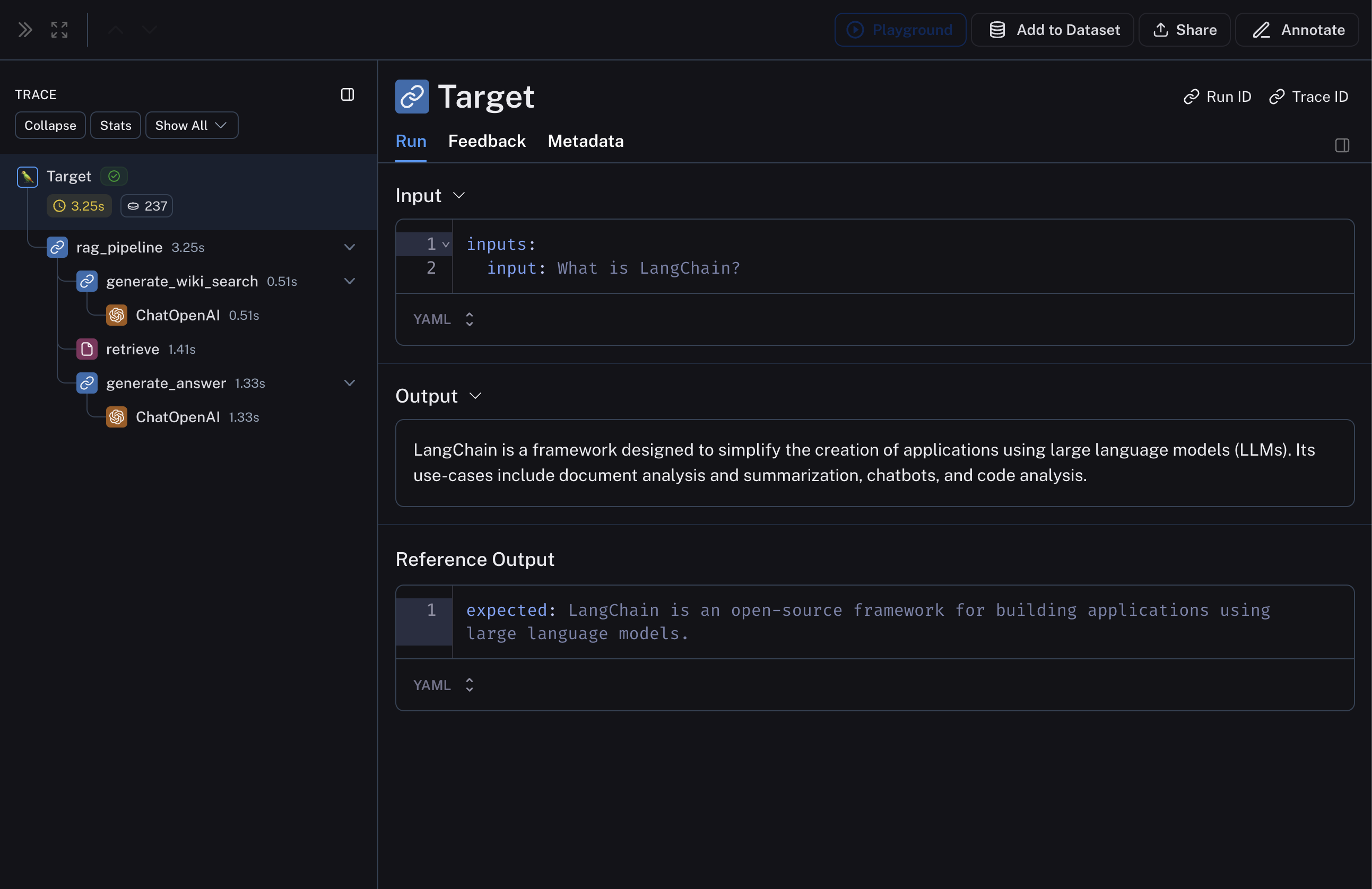
2. 创建数据集和示例以评估流水线
我们正在构建一个非常简单的数据集,其中包含几个示例来评估流水线。
需要 langsmith>=0.3.13
python
from langsmith import Client

ls_client = Client()
dataset_name = "Wikipedia RAG"

if not ls_client.has_dataset(dataset_name=dataset_name):
    dataset = ls_client.create_dataset(dataset_name=dataset_name)
    examples = [
      {"inputs": {"question": "What is LangChain?"}},
      {"inputs": {"question": "What is LangSmith?"}},
    ]
    ls_client.create_examples(
      dataset_id=dataset.id,
      examples=examples,
    )
typescript
import { Client } from "langsmith";

const client = new Client();
const examples = [
  [
    "What is LangChain?",
    "LangChain is an open-source framework for building applications using large language models.",
  ],
  [
    "What is LangSmith?",
    "LangSmith is an observability and evaluation tool for LLM products, built by LangChain Inc.",
  ],
];
const datasetName = "Wikipedia RAG";
const inputs = examples.map(([input, _]) => ({ input }));
const outputs = examples.map(([_, expected]) => ({ expected }));
const dataset = await client.createDataset(datasetName);
await client.createExamples({ datasetId: dataset.id, inputs, outputs });
3. 定义您的自定义评估器
如上所述,我们将定义两个评估器:一个评估检索到的文档相对于输入查询的相关性,另一个评估生成的答案相对于检索到的文档是否存在幻觉。我们将使用 LangChain LLM 包装器,以及 with_structured_output 来定义幻觉评估器。
这里的关键在于,评估器函数应遍历 run / rootRun 参数以访问流水线的中间步骤。然后,评估器可以处理中间步骤的输入和输出,根据所需标准进行评估。
为方便起见,示例使用了 langchain,但这并非必需。
python
from langchain.chat_models import init_chat_model
from langsmith.schemas import Run
from pydantic import BaseModel, Field

def document_relevance(run: Run) -> bool:
    """Checks if retriever input exists in the retrieved docs."""
    qa_pipeline_run = next(
        r for run in run.child_runs if r.name == "qa_pipeline"
    )
    retrieve_run = next(
        r for run in qa_pipeline_run.child_runs if r.name == "retrieve"
    )
    page_contents = "\n\n".join(
        doc["page_content"] for doc in retrieve_run.outputs["output"]
    )
    return retrieve_run.inputs["query"] in page_contents

# Data model
class GradeHallucinations(BaseModel):
    """Binary score for hallucination present in generation answer."""
    is_grounded: bool = Field(..., description="True if the answer is grounded in the facts, False otherwise.")

# LLM with structured output for grading hallucinations
# For more see: https://python.langchain.com/docs/how_to/structured_output/
grader_llm= init_chat_model("gpt-4o-mini", temperature=0).with_structured_output(
    GradeHallucinations,
    method="json_schema",
    strict=True,
)

def no_hallucination(run: Run) -> bool:
    """Check if the answer is grounded in the documents.
    Return True if there is no hallucination, False otherwise.
    """
    # Get documents and answer
    qa_pipeline_run = next(
        r for r in run.child_runs if r.name == "qa_pipeline"
    )
    retrieve_run = next(
        r for r in qa_pipeline_run.child_runs if r.name == "retrieve"
    )
    retrieved_content = "\n\n".join(
        doc["page_content"] for doc in retrieve_run.outputs["output"]
    )

    # Construct prompt
    instructions = (
        "You are a grader assessing whether an LLM generation is grounded in / "
        "supported by a set of retrieved facts. Give a binary score 1 or 0, "
        "where 1 means that the answer is grounded in / supported by the set of facts."
    )
    messages = [
        {"role": "system", "content": instructions},
        {"role": "user", "content": f"Set of facts:\n{retrieved_content}\n\nLLM generation: {run.outputs['answer']}"},
    ]
    grade = grader_llm.invoke(messages)
    return grade.is_grounded
typescript
import { EvaluationResult } from "langsmith/evaluation";
import { Run, Example } from "langsmith/schemas";
import { ChatPromptTemplate } from "@langchain/core/prompts";
import { ChatOpenAI } from "@langchain/openai";
import { z } from "zod";

function findNestedRun(run: Run, search: (run: Run) => boolean): Run | null {
  const queue: Run[] = [run];
  while (queue.length > 0) {
    const currentRun = queue.shift()!;
    if (search(currentRun)) return currentRun;
    queue.push(...currentRun.child_runs);
  }
  return null;
}

// A very simple evaluator that checks to see if the input of the retrieval step exists
// in the retrieved docs.
function documentRelevance(rootRun: Run, example: Example): EvaluationResult {
  const retrieveRun = findNestedRun(rootRun, (run) => run.name === "retrieve");
  const docs: Array<{ page_content: string }> | undefined =
    retrieveRun.outputs?.outputs;
  const pageContents = docs?.map((doc) => doc.page_content).join("\n\n");
  const score = pageContents.includes(retrieveRun.inputs?.query);
  return { key: "simple_document_relevance", score };
}

async function hallucination(
  rootRun: Run,
  example: Example
): Promise<EvaluationResult> {
  const rag = findNestedRun(rootRun, (run) => run.name === "ragPipeline");
  const retrieve = findNestedRun(rootRun, (run) => run.name === "retrieve");
  const docs: Array<{ page_content: string }> | undefined =
    retrieve.outputs?.outputs;
  const documents = docs?.map((doc) => doc.page_content).join("\n\n");

  const prompt = ChatPromptTemplate.fromMessages<{
    documents: string;
    generation: string;
  }>([
    [
      "system",
      [
        `You are a grader assessing whether an LLM generation is grounded in / supported by a set of retrieved facts. \n`,
        `Give a binary score 1 or 0, where 1 means that the answer is grounded in / supported by the set of facts.`,
      ].join("\n"),
    ],
    [
      "human",
      "Set of facts: \n\n {documents} \n\n LLM generation: {generation}",
    ],
  ]);

  const llm = new ChatOpenAI({
    model: "gpt-4o-mini",
    temperature: 0,
  }).withStructuredOutput(
    z
      .object({
        binary_score: z
          .number()
          .describe("Answer is grounded in the facts, 1 or 0"),
      })
      .describe("Binary score for hallucination present in generation answer.")
  );

  const grader = prompt.pipe(llm);
  const score = await grader.invoke({
    documents,
    generation: rag.outputs?.outputs,
  });
  return { key: "answer_hallucination", score: score.binary_score };
}
4. 评估流水线
最后,我们将使用上面定义的自定义评估器运行 evaluate。
python
def qa_wrapper(inputs: dict) -> dict:
  """Wrap the qa_pipeline so it can accept the Example.inputs dict as input."""
  return {"answer": qa_pipeline(inputs["question"])}

experiment_results = ls_client.evaluate(
    qa_wrapper,
    data=dataset_name,
    evaluators=[document_relevance, no_hallucination],
    experiment_prefix="rag-wiki-oai"
)
typescript
import { evaluate } from "langsmith/evaluation";

await evaluate((inputs) => ragPipeline({ question: inputs.input }), {
  data: datasetName,
  evaluators: [hallucination, documentRelevance],
  experimentPrefix: "rag-wiki-oai",
});
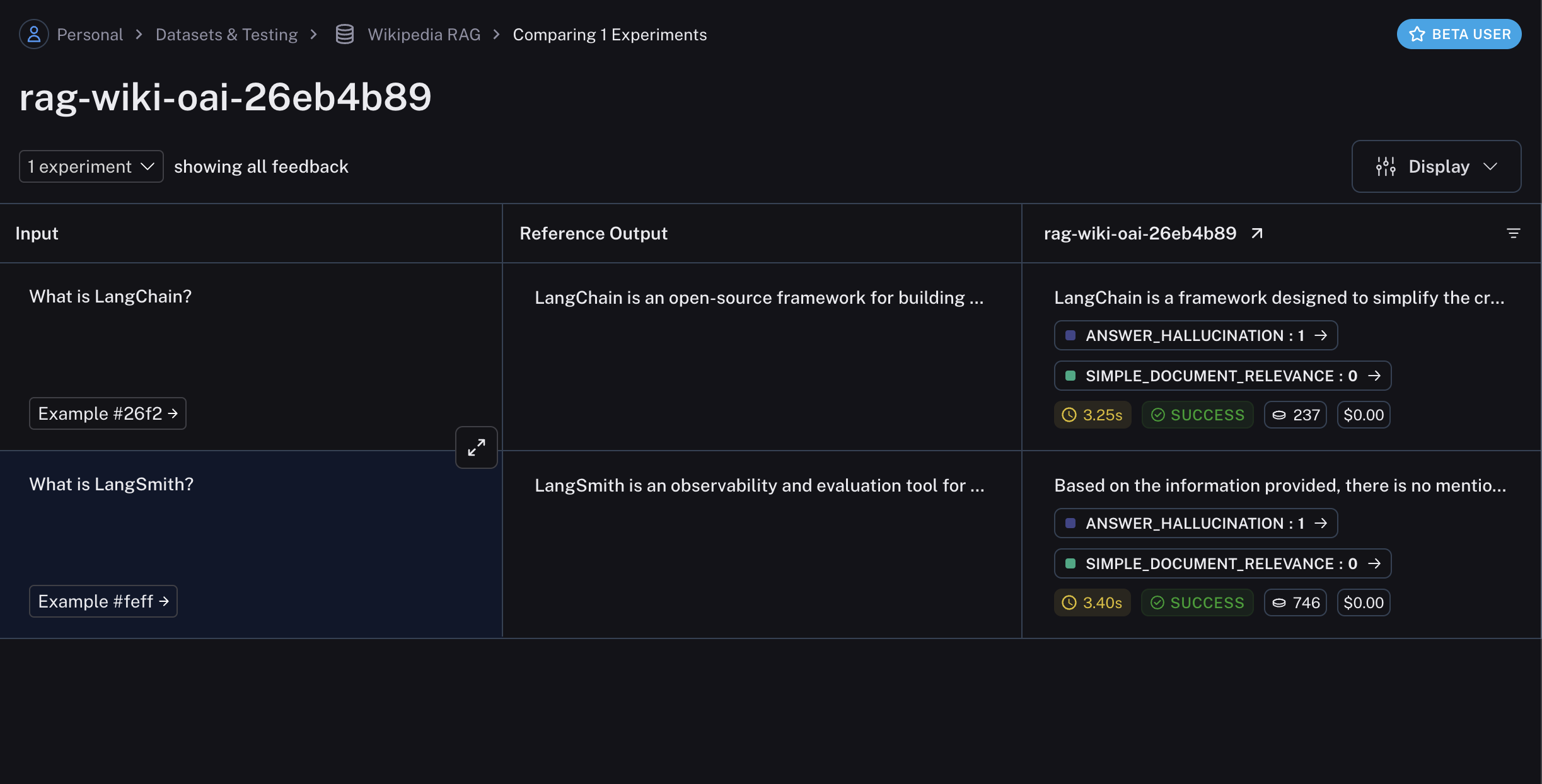
实验将包含评估结果,包括评估器的分数和评论: