
主题
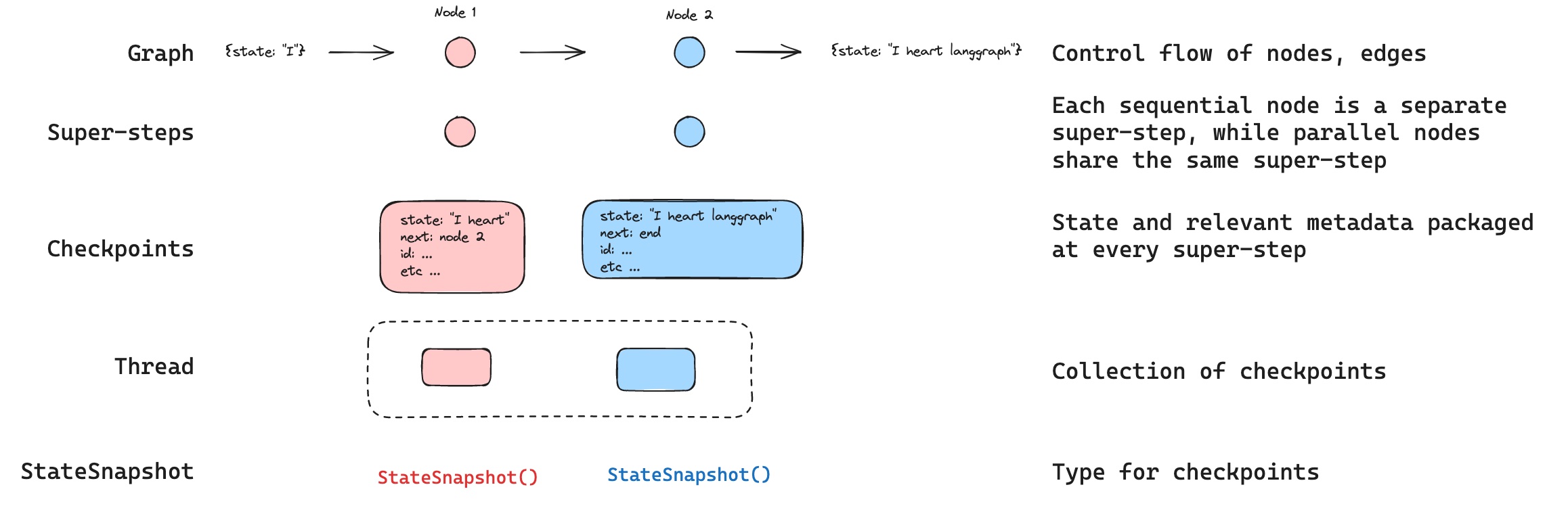
LangGraph 内置了一个通过检查点器实现的持久化层。当你使用检查点器编译图时,检查点器会在每个超级步骤保存图状态的检查点。这些检查点被保存到一个线程中,可以在图执行后访问。因为线程允许在执行后访问图的状态,所以包括人在回路、记忆、时间旅行和容错在内的几个强大功能都成为可能。下面,我们将更详细地讨论这些概念。
Agent Server 自动处理检查点 当使用 Agent Server 时,你不需要手动实现或配置检查点器。服务器会在幕后为你处理所有的持久化基础设施。
线程
线程是检查点器为每个保存的检查点分配的唯一 ID 或线程标识符。它包含一系列运行的累积状态。当运行被执行时,助手底层图的状态将被持久化到线程中。
当使用检查点器调用图时,你必须在配置的可配置部分指定一个thread_id:
python
{"configurable": {"thread_id": "1"}}可以检索线程的当前和历史状态。为了持久化状态,必须在执行运行之前创建线程。LangSmith API 提供了几个用于创建和管理线程及线程状态的端点。更多详情请参阅 API 参考。
检查点器使用thread_id作为存储和检索检查点的主键。没有它,检查点器无法保存状态或在中断后恢复执行,因为检查点器使用thread_id来加载保存的状态。
检查点
线程在特定时间点的状态称为检查点。检查点是在每个超级步骤保存的图状态快照,由StateSnapshot对象表示,具有以下关键属性:
config:与此检查点关联的配置。metadata:与此检查点关联的元数据。values:此时状态通道的值。next:图中接下来要执行的节点名称的元组。tasks:包含要执行的下一个任务信息的PregelTask对象元组。如果该步骤之前尝试过,它将包含错误信息。如果图是从节点内部动态中断的,任务将包含与中断相关的额外数据。
检查点被持久化,并可用于在以后恢复线程的状态。
让我们看看当调用一个简单图时保存了哪些检查点:
python
from langgraph.graph import StateGraph, START, END
from langgraph.checkpoint.memory import InMemorySaver
from langchain_core.runnables import RunnableConfig
from typing import Annotated
from typing_extensions import TypedDict
from operator import add

class State(TypedDict):
    foo: str
    bar: Annotated[list[str], add]

def node_a(state: State):
    return {"foo": "a", "bar": ["a"]}

def node_b(state: State):
    return {"foo": "b", "bar": ["b"]}

workflow = StateGraph(State)
workflow.add_node(node_a)
workflow.add_node(node_b)
workflow.add_edge(START, "node_a")
workflow.add_edge("node_a", "node_b")
workflow.add_edge("node_b", END)

checkpointer = InMemorySaver()
graph = workflow.compile(checkpointer=checkpointer)

config: RunnableConfig = {"configurable": {"thread_id": "1"}}
graph.invoke({"foo": "", "bar":[]}, config)
运行图后,我们预计会看到恰好 4 个检查点:
- 下一个要执行的节点为
START的空检查点 - 包含用户输入
{'foo': '', 'bar': []}且下一个要执行的节点为node_a的检查点 - 包含
node_a的输出{'foo': 'a', 'bar': ['a']}且下一个要执行的节点为node_b的检查点 - 包含
node_b的输出{'foo': 'b', 'bar': ['a', 'b']}且没有下一个要执行节点的检查点
请注意,bar 通道的值包含来自两个节点的输出,因为我们为 bar 通道设置了归约器。
获取状态
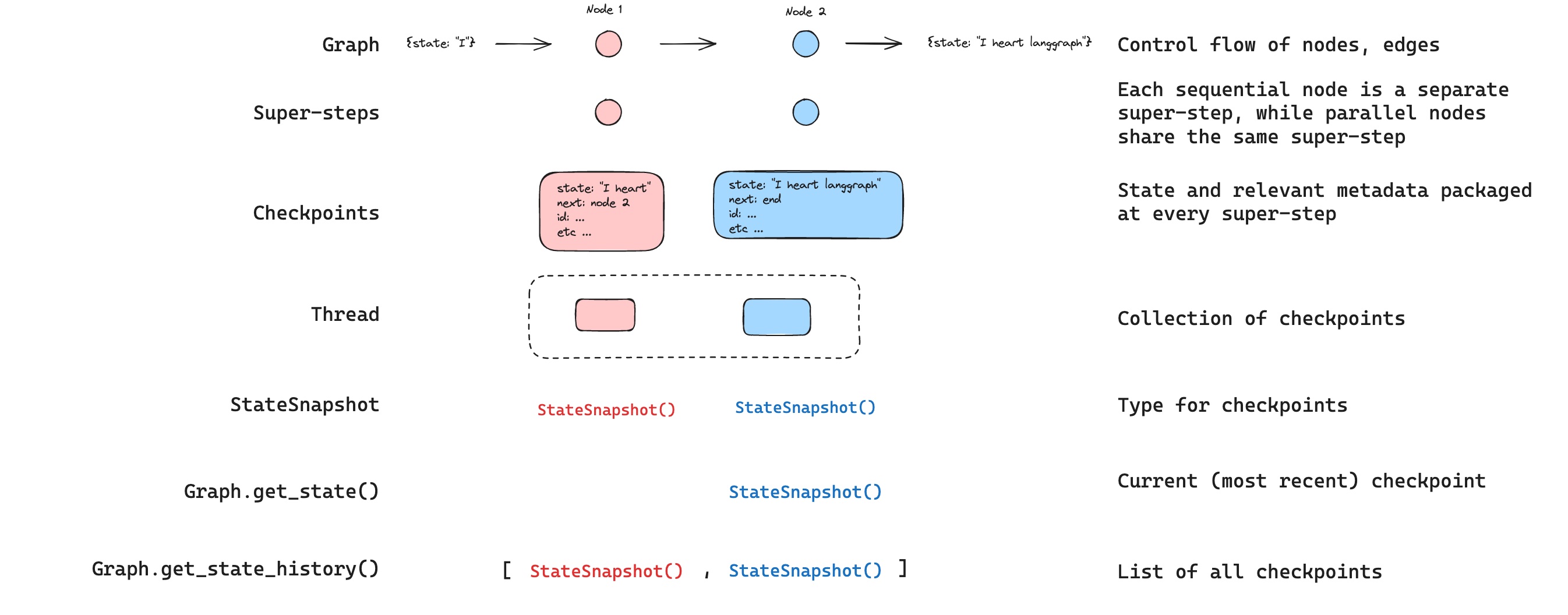
与保存的图状态交互时,你必须指定一个线程标识符。你可以通过调用 graph.get_state(config) 来查看图的_最新_状态。这将返回一个 StateSnapshot 对象,该对象对应于配置中提供的线程 ID 关联的最新检查点,或者如果提供了,则对应于该线程的检查点 ID 关联的检查点。
python
# get the latest state snapshot
config = {"configurable": {"thread_id": "1"}}
graph.get_state(config)

# get a state snapshot for a specific checkpoint_id
config = {"configurable": {"thread_id": "1", "checkpoint_id": "1ef663ba-28fe-6528-8002-5a559208592c"}}
graph.get_state(config)在我们的示例中,get_state 的输出将如下所示:
StateSnapshot(
    values={'foo': 'b', 'bar': ['a', 'b']},
    next=(),
    config={'configurable': {'thread_id': '1', 'checkpoint_ns': '', 'checkpoint_id': '1ef663ba-28fe-6528-8002-5a559208592c'}},
    metadata={'source': 'loop', 'writes': {'node_b': {'foo': 'b', 'bar': ['b']}}, 'step': 2},
    created_at='2024-08-29T19:19:38.821749+00:00',
    parent_config={'configurable': {'thread_id': '1', 'checkpoint_ns': '', 'checkpoint_id': '1ef663ba-28f9-6ec4-8001-31981c2c39f8'}}, tasks=()
)
获取状态历史
你可以通过调用 graph.get_state_history(config) 来获取给定线程的图执行完整历史。这将返回与配置中提供的线程 ID 关联的 StateSnapshot 对象列表。重要的是,检查点将按时间顺序排列,最新的检查点 / StateSnapshot 位于列表首位。
python
config = {"configurable": {"thread_id": "1"}}
list(graph.get_state_history(config))在我们的示例中,get_state_history 的输出将如下所示:
[
    StateSnapshot(
        values={'foo': 'b', 'bar': ['a', 'b']},
        next=(),
        config={'configurable': {'thread_id': '1', 'checkpoint_ns': '', 'checkpoint_id': '1ef663ba-28fe-6528-8002-5a559208592c'}},
        metadata={'source': 'loop', 'writes': {'node_b': {'foo': 'b', 'bar': ['b']}}, 'step': 2},
        created_at='2024-08-29T19:19:38.821749+00:00',
        parent_config={'configurable': {'thread_id': '1', 'checkpoint_ns': '', 'checkpoint_id': '1ef663ba-28f9-6ec4-8001-31981c2c39f8'}},
        tasks=(),
    ),
    StateSnapshot(
        values={'foo': 'a', 'bar': ['a']},
        next=('node_b',),
        config={'configurable': {'thread_id': '1', 'checkpoint_ns': '', 'checkpoint_id': '1ef663ba-28f9-6ec4-8001-31981c2c39f8'}},
        metadata={'source': 'loop', 'writes': {'node_a': {'foo': 'a', 'bar': ['a']}}, 'step': 1},
        created_at='2024-08-29T19:19:38.819946+00:00',
        parent_config={'configurable': {'thread_id': '1', 'checkpoint_ns': '', 'checkpoint_id': '1ef663ba-28f4-6b4a-8000-ca575a13d36a'}},
        tasks=(PregelTask(id='6fb7314f-f114-5413-a1f3-d37dfe98ff44', name='node_b', error=None, interrupts=()),),
    ),
    StateSnapshot(
        values={'foo': '', 'bar': []},
        next=('node_a',),
        config={'configurable': {'thread_id': '1', 'checkpoint_ns': '', 'checkpoint_id': '1ef663ba-28f4-6b4a-8000-ca575a13d36a'}},
        metadata={'source': 'loop', 'writes': None, 'step': 0},
        created_at='2024-08-29T19:19:38.817813+00:00',
        parent_config={'configurable': {'thread_id': '1', 'checkpoint_ns': '', 'checkpoint_id': '1ef663ba-28f0-6c66-bfff-6723431e8481'}},
        tasks=(PregelTask(id='f1b14528-5ee5-579c-949b-23ef9bfbed58', name='node_a', error=None, interrupts=()),),
    ),
    StateSnapshot(
        values={'bar': []},
        next=('__start__',),
        config={'configurable': {'thread_id': '1', 'checkpoint_ns': '', 'checkpoint_id': '1ef663ba-28f0-6c66-bfff-6723431e8481'}},
        metadata={'source': 'input', 'writes': {'foo': ''}, 'step': -1},
        created_at='2024-08-29T19:19:38.816205+00:00',
        parent_config=None,
        tasks=(PregelTask(id='6d27aa2e-d72b-5504-a36f-8620e54a76dd', name='__start__', error=None, interrupts=()),),
    )
]
重放
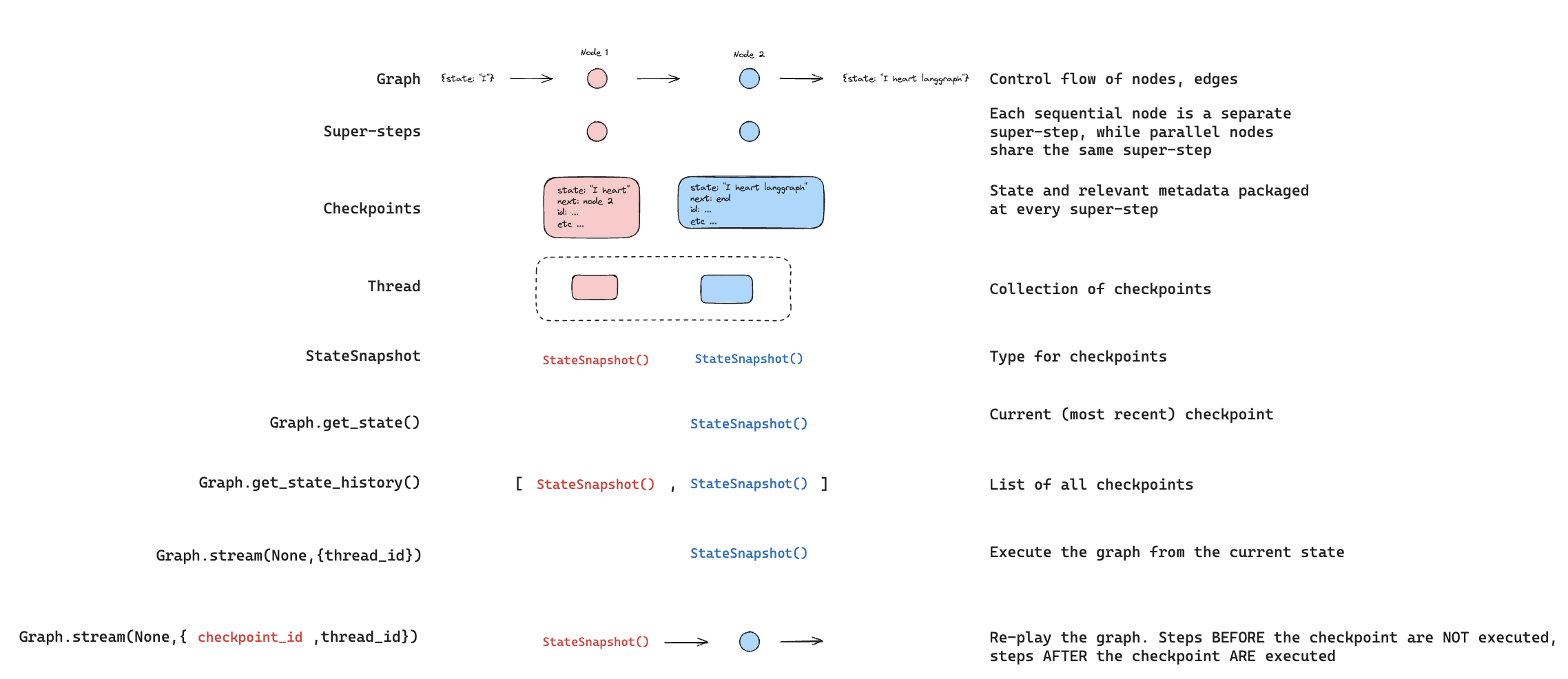
也可以回放先前的图执行。如果我们使用 thread_id 和 checkpoint_id 来 invoke 一个图,那么我们将_重放_对应于 checkpoint_id 的检查点_之前_已执行的步骤,并且只执行检查点_之后_的步骤。
thread_id是线程的 ID。checkpoint_id是指向线程内特定检查点的标识符。
你必须在调用图时将这些作为配置的可配置部分传递:
python
config = {"configurable": {"thread_id": "1", "checkpoint_id": "0c62ca34-ac19-445d-bbb0-5b4984975b2a"}}
graph.invoke(None, config=config)
重要的是,LangGraph 知道某个特定步骤是否之前已执行过。如果是,LangGraph 只是简单地_重放_图中的该特定步骤,并且不重新执行该步骤,但仅针对提供的 checkpoint_id _之前_的步骤。checkpoint_id _之后_的所有步骤都将被执行(即一个新的分支),即使它们之前已经执行过。请参阅此关于时间旅行的操作指南以了解更多关于重放的信息。
更新状态
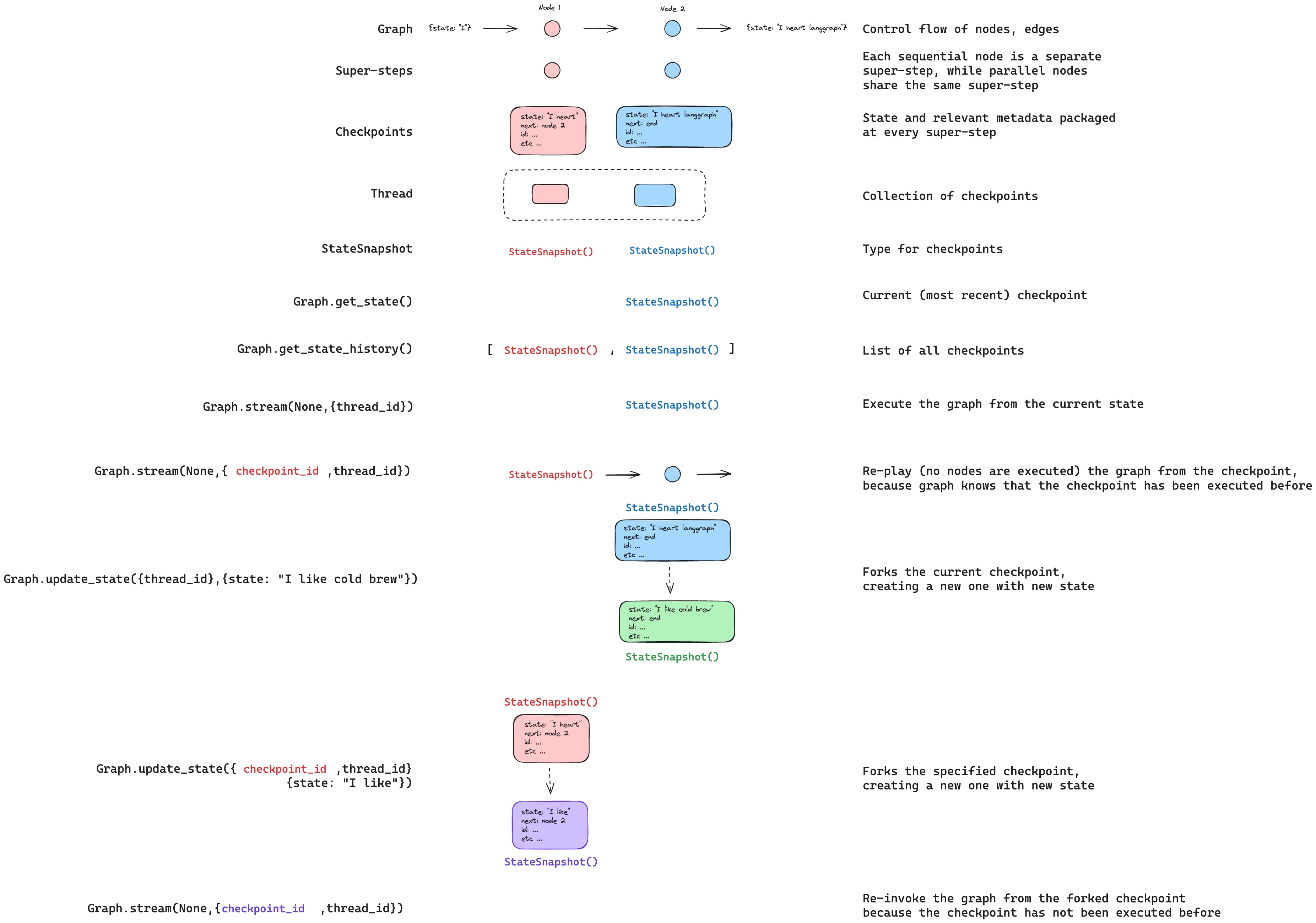
除了从特定的检查点重放图之外,我们还可以_编辑_图状态。我们使用 update_state 来实现这一点。该方法接受三个不同的参数:
config
配置应包含指定要更新哪个线程的 thread_id。当只传递 thread_id 时,我们更新(或分支)当前状态。或者,如果我们包含 checkpoint_id 字段,那么我们将分支该选定的检查点。
values
这些是用于更新状态的值。请注意,此更新与来自节点的任何更新完全相同。这意味着这些值将被传递给归约器函数,如果它们为图状态中的某些通道定义了。这意味着 update_state 不会自动覆盖每个通道的通道值,而只会覆盖没有归约器的通道。让我们看一个例子。
假设你已使用以下模式定义了图的状态(参见上面的完整示例):
python
from typing import Annotated
from typing_extensions import TypedDict
from operator import add

class State(TypedDict):
    foo: int
    bar: Annotated[list[str], add]
现在假设图的当前状态是
{"foo": 1, "bar": ["a"]}如果你按如下方式更新状态:
python
graph.update_state(config, {"foo": 2, "bar": ["b"]})那么图的新状态将是:
{"foo": 2, "bar": ["a", "b"]}foo 键(通道)被完全更改(因为该通道没有指定归约器,所以 update_state 会覆盖它)。但是,为 bar 键指定了归约器,因此它将 "b" 附加到 bar 的状态。
as_node
调用 update_state 时可以可选指定的最后一件事是 as_node。如果你提供了它,更新将应用为好像来自节点 as_node。如果未提供 as_node,它将设置为最后更新状态的节点(如果不模糊)。这很重要的原因是,接下来要执行的步骤取决于最后给出更新的节点,因此这可以用来控制哪个节点接下来执行。请参阅此关于时间旅行的操作指南以了解更多关于分支状态的信息。
记忆存储
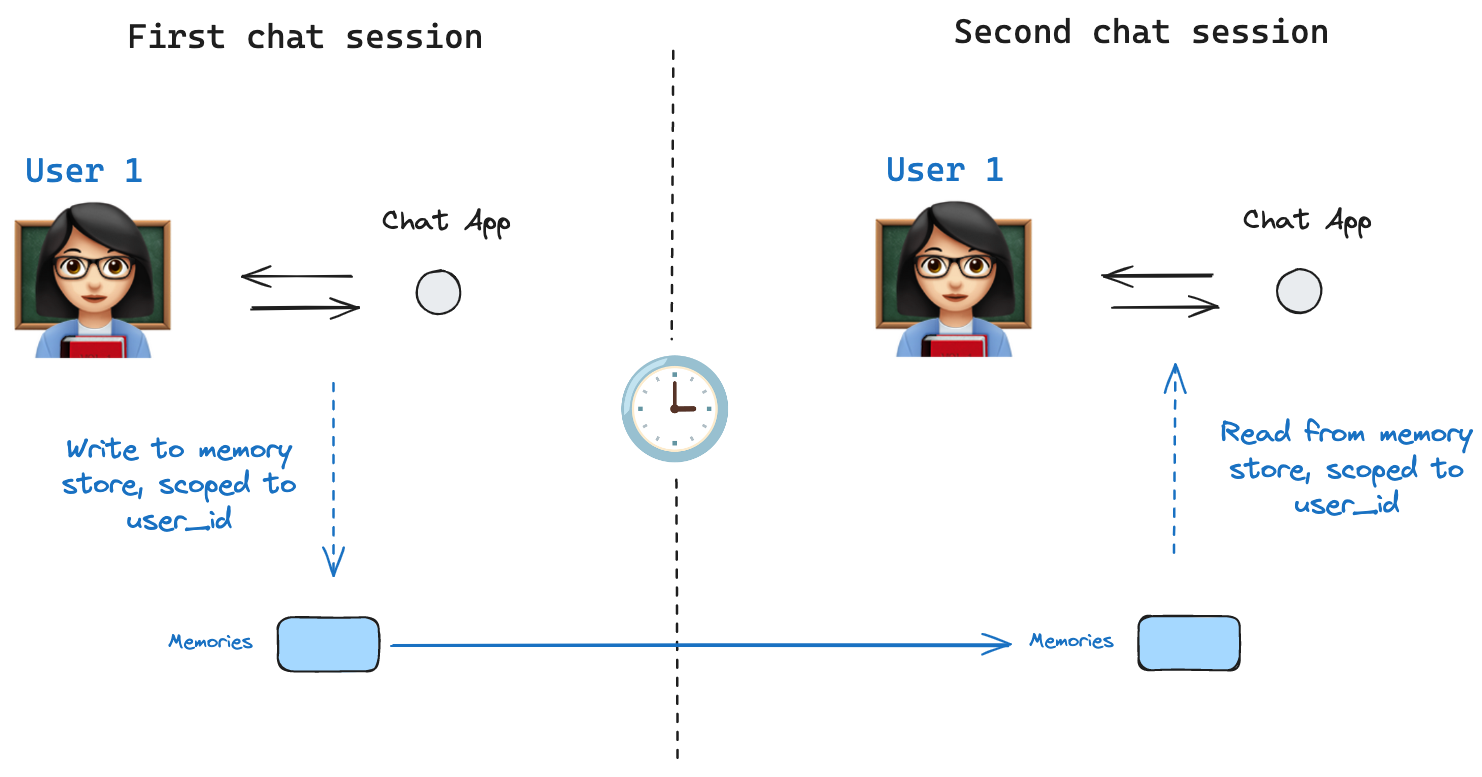
状态模式指定了一组在图执行时填充的键。如上所述,状态可以由检查点器在每个图步骤写入线程,从而实现状态持久化。
但是,如果我们想_跨线程_保留一些信息呢?考虑聊天机器人的情况,我们希望在该用户的所有聊天对话(例如,线程)中保留关于该用户的特定信息!
仅使用检查点器,我们无法跨线程共享信息。这引出了对 Store 接口的需求。作为说明,我们可以定义一个 InMemoryStore 来跨线程存储关于用户的信息。我们只需像以前一样使用检查点器编译我们的图,并加上我们的新 in_memory_store 变量。
LangGraph API 自动处理存储 当使用 LangGraph API 时,你不需要手动实现或配置存储。API 会在幕后为你处理所有的存储基础设施。
基本用法
首先,让我们在不使用 LangGraph 的情况下单独展示这一点。
python
from langgraph.store.memory import InMemoryStore
in_memory_store = InMemoryStore()记忆通过一个元组进行命名空间划分,在这个特定示例中将是 (<user_id>, "memories")。命名空间可以是任意长度并代表任何内容,不一定必须是用户特定的。
python
user_id = "1"
namespace_for_memory = (user_id, "memories")
我们使用 store.put 方法将记忆保存到我们命名空间中的存储。当我们这样做时,我们指定命名空间(如上定义)以及记忆的键值对:键只是记忆的唯一标识符(memory_id),值(一个字典)是记忆本身。
python
memory_id = str(uuid.uuid4())
memory = {"food_preference" : "I like pizza"}
in_memory_store.put(namespace_for_memory, memory_id, memory)
我们可以使用 store.search 方法读取我们命名空间中的记忆,该方法将返回给定用户的所有记忆作为列表。最新的记忆是列表中的最后一个。
python
memories = in_memory_store.search(namespace_for_memory)
memories[-1].dict()
{'value': {'food_preference': 'I like pizza'},
 'key': '07e0caf4-1631-47b7-b15f-65515d4c1843',
 'namespace': ['1', 'memories'],
 'created_at': '2024-10-02T17:22:31.590602+00:00',
 'updated_at': '2024-10-02T17:22:31.590605+00:00'}
每种记忆类型都是一个具有某些属性的 Python 类(Item)。我们可以通过如上所示的 .dict 转换将其作为字典访问。
它具有的属性是:
value:此记忆的值(本身是一个字典)key:此记忆在此命名空间中的唯一键namespace:字符串列表,此记忆类型的命名空间created_at:此记忆创建时的时间戳updated_at:此记忆更新时的时间戳
语义搜索
除了简单的检索,存储还支持语义搜索,允许你根据含义而不是精确匹配来查找记忆。要启用此功能,请使用嵌入模型配置存储:
python
from langchain.embeddings import init_embeddings

store = InMemoryStore(
    index={
        "embed": init_embeddings("openai:text-embedding-3-small"),  # Embedding provider
        "dims": 1536,                              # Embedding dimensions
        "fields": ["food_preference", "$"]              # Fields to embed
    }
)
现在搜索时,你可以使用自然语言查询来查找相关记忆:
python
# Find memories about food preferences
# (This can be done after putting memories into the store)
memories = store.search(
    namespace_for_memory,
    query="What does the user like to eat?",
    limit=3  # Return top 3 matches
)
你可以通过配置 fields 参数或在存储记忆时指定 index 参数来控制记忆的哪些部分被嵌入:
python
# Store with specific fields to embed
store.put(
    namespace_for_memory,
    str(uuid.uuid4()),
    {
        "food_preference": "I love Italian cuisine",
        "context": "Discussing dinner plans"
    },
    index=["food_preference"]  # Only embed "food_preferences" field
)

# Store without embedding (still retrievable, but not searchable)
store.put(
    namespace_for_memory,
    str(uuid.uuid4()),
    {"system_info": "Last updated: 2024-01-01"},
    index=False
)
在 LangGraph 中使用
有了这一切,我们在 LangGraph 中使用 in_memory_store。in_memory_store 与检查点器协同工作:检查点器将状态保存到线程,如上所述,而 in_memory_store 允许我们存储任意信息以供_跨_线程访问。我们使用检查点器和 in_memory_store 编译图,如下所示。
python
from langgraph.checkpoint.memory import InMemorySaver

# We need this because we want to enable threads (conversations)
checkpointer = InMemorySaver()

# ... Define the graph ...

# Compile the graph with the checkpointer and store
graph = graph.compile(checkpointer=checkpointer, store=in_memory_store)
我们像之前一样,使用 thread_id 来调用图,同时还会使用 user_id,正如我们上面展示的,我们将用这个 user_id 来为这个特定用户的记忆进行命名空间划分。
python
# Invoke the graph
user_id = "1"
config = {"configurable": {"thread_id": "1", "user_id": user_id}}

# First let's just say hi to the AI
for update in graph.stream(
    {"messages": [{"role": "user", "content": "hi"}]}, config, stream_mode="updates"
):
    print(update)
我们可以在 任何节点 中通过传递 store: BaseStore 和 config: RunnableConfig 作为节点参数来访问 in_memory_store 和 user_id。以下是如何在节点中使用语义搜索来查找相关记忆的示例:
python
def update_memory(state: MessagesState, config: RunnableConfig, *, store: BaseStore):

    # Get the user id from the config
    user_id = config["configurable"]["user_id"]

    # Namespace the memory
    namespace = (user_id, "memories")

    # ... Analyze conversation and create a new memory

    # Create a new memory ID
    memory_id = str(uuid.uuid4())

    # We create a new memory
    store.put(namespace, memory_id, {"memory": memory})
正如我们上面展示的,我们也可以在任何节点中访问存储,并使用 store.search 方法来获取记忆。请注意,记忆会以可转换为字典的对象列表形式返回。
python
memories[-1].dict()
{'value': {'food_preference': 'I like pizza'},
 'key': '07e0caf4-1631-47b7-b15f-65515d4c1843',
 'namespace': ['1', 'memories'],
 'created_at': '2024-10-02T17:22:31.590602+00:00',
 'updated_at': '2024-10-02T17:22:31.590605+00:00'}
我们可以访问这些记忆并在模型调用中使用它们。
python
def call_model(state: MessagesState, config: RunnableConfig, *, store: BaseStore):
    # Get the user id from the config
    user_id = config["configurable"]["user_id"]

    # Namespace the memory
    namespace = (user_id, "memories")

    # Search based on the most recent message
    memories = store.search(
        namespace,
        query=state["messages"][-1].content,
        limit=3
    )
    info = "\n".join([d.value["memory"] for d in memories])

    # ... Use memories in the model call
如果我们创建一个新线程,只要 user_id 相同,我们仍然可以访问相同的记忆。
python
# Invoke the graph
config = {"configurable": {"thread_id": "2", "user_id": "1"}}

# Let's say hi again
for update in graph.stream(
    {"messages": [{"role": "user", "content": "hi, tell me about my memories"}]}, config, stream_mode="updates"
):
    print(update)
当我们使用 LangSmith 时,无论是在本地(例如在 Studio 中)还是 使用 LangSmith 托管,基础存储默认都是可用的,无需在图编译时指定。但是,要启用语义搜索,您 确实 需要在 langgraph.json 文件中配置索引设置。例如:
json
{
    ...
    "store": {
        "index": {
            "embed": "openai:text-embeddings-3-small",
            "dims": 1536,
            "fields": ["$"]
        }
    }
}
有关更多详细信息和配置选项,请参阅 部署指南。
检查点器库
在底层,检查点功能由符合 BaseCheckpointSaver 接口的检查点器对象提供支持。LangGraph 提供了几种检查点器实现,都是通过独立的、可安装的库实现的:
langgraph-checkpoint:检查点保存器的基础接口(BaseCheckpointSaver)和序列化/反序列化接口(SerializerProtocol)。包含用于实验的内存检查点器实现(InMemorySaver)。LangGraph 内置了langgraph-checkpoint。langgraph-checkpoint-sqlite:使用 SQLite 数据库的 LangGraph 检查点器实现(SqliteSaver/AsyncSqliteSaver)。适用于实验和本地工作流。需要单独安装。langgraph-checkpoint-postgres:使用 Postgres 数据库的高级检查点器(PostgresSaver/AsyncPostgresSaver),在 LangSmith 中使用。适用于生产环境。需要单独安装。
检查点器接口
每个检查点器都符合 BaseCheckpointSaver 接口,并实现以下方法:
.put- 存储一个检查点及其配置和元数据。.put_writes- 存储与检查点关联的中间写入(即 待定写入)。.get_tuple- 根据给定配置(thread_id和checkpoint_id)获取检查点元组。这用于在graph.get_state()中填充StateSnapshot。.list- 列出符合给定配置和筛选条件的检查点。这用于在graph.get_state_history()中填充状态历史记录。
如果检查点器用于异步图执行(即通过 .ainvoke、.astream、.abatch 执行图),则将使用上述方法的异步版本(.aput、.aput_writes、.aget_tuple、.alist)。
要异步运行图,您可以使用 InMemorySaver,或者 Sqlite/Postgres 检查点器的异步版本——AsyncSqliteSaver / AsyncPostgresSaver 检查点器。
序列化器
当检查点器保存图状态时,它们需要序列化状态中的通道值。这是通过序列化器对象完成的。
langgraph_checkpoint 定义了用于实现序列化器的 协议,并提供了一个默认实现(JsonPlusSerializer),该实现处理多种类型,包括 LangChain 和 LangGraph 原语、日期时间、枚举等。
使用 pickle 进行序列化
默认的序列化器 JsonPlusSerializer 在底层使用 ormsgpack 和 JSON,这不适用于所有类型的对象。
如果您希望对我们当前的 msgpack 编码器不支持的对象(例如 Pandas 数据框)回退到 pickle,可以使用 JsonPlusSerializer 的 pickle_fallback 参数:
python
from langgraph.checkpoint.memory import InMemorySaver
from langgraph.checkpoint.serde.jsonplus import JsonPlusSerializer

# ... Define the graph ...
graph.compile(
    checkpointer=InMemorySaver(serde=JsonPlusSerializer(pickle_fallback=True))
)
加密
检查点器可以选择性地加密所有持久化的状态。要启用此功能,请将 EncryptedSerializer 的实例传递给任何 BaseCheckpointSaver 实现的 serde 参数。创建加密序列化器最简单的方法是通过 from_pycryptodome_aes,它从 LANGGRAPH_AES_KEY 环境变量中读取 AES 密钥(或接受 key 参数):
python
import sqlite3

from langgraph.checkpoint.serde.encrypted import EncryptedSerializer
from langgraph.checkpoint.sqlite import SqliteSaver

serde = EncryptedSerializer.from_pycryptodome_aes()  # reads LANGGRAPH_AES_KEY
checkpointer = SqliteSaver(sqlite3.connect("checkpoint.db"), serde=serde)
python
from langgraph.checkpoint.serde.encrypted import EncryptedSerializer
from langgraph.checkpoint.postgres import PostgresSaver

serde = EncryptedSerializer.from_pycryptodome_aes()
checkpointer = PostgresSaver.from_conn_string("postgresql://...", serde=serde)
checkpointer.setup()
在 LangSmith 上运行时,只要存在 LANGGRAPH_AES_KEY,加密就会自动启用,因此您只需要提供环境变量。其他加密方案可以通过实现 CipherProtocol 并将其提供给 EncryptedSerializer 来使用。
功能
人在回路
首先,检查点器通过允许人类检查、中断和批准图步骤,促进了 人在回路工作流。这些工作流需要检查点器,因为人类必须能够随时查看图的状态,并且图必须在人类对状态进行任何更新后能够恢复执行。有关示例,请参阅 操作指南。
记忆
其次,检查点器允许在交互之间实现 "记忆"。在重复的人类交互(如对话)中,任何后续消息都可以发送到该线程,该线程将保留对先前消息的记忆。有关如何使用检查点器添加和管理对话记忆的信息,请参阅 添加记忆。
时间旅行
第三,检查点器允许 "时间旅行",使用户能够重放先前的图执行,以审查和/或调试特定的图步骤。此外,检查点器使得可以在任意检查点处分叉图状态,以探索不同的轨迹。
容错性
最后,检查点还提供了容错性和错误恢复能力:如果一个或多个节点在某个超步中失败,您可以从最后一个成功的步骤重新启动图。此外,当图节点在某个超步中执行失败时,LangGraph 会存储该超步中任何其他成功完成的节点的待定检查点写入,这样无论何时我们从该超步恢复图执行,都不会重新运行成功的节点。
待定写入
此外,当图节点在某个超步中执行失败时,LangGraph 会存储该超步中任何其他成功完成的节点的待定检查点写入,这样无论何时我们从该超步恢复图执行,都不会重新运行成功的节点。