
主题
概述
在本教程中,我们将使用 LangGraph 构建一个检索智能体。
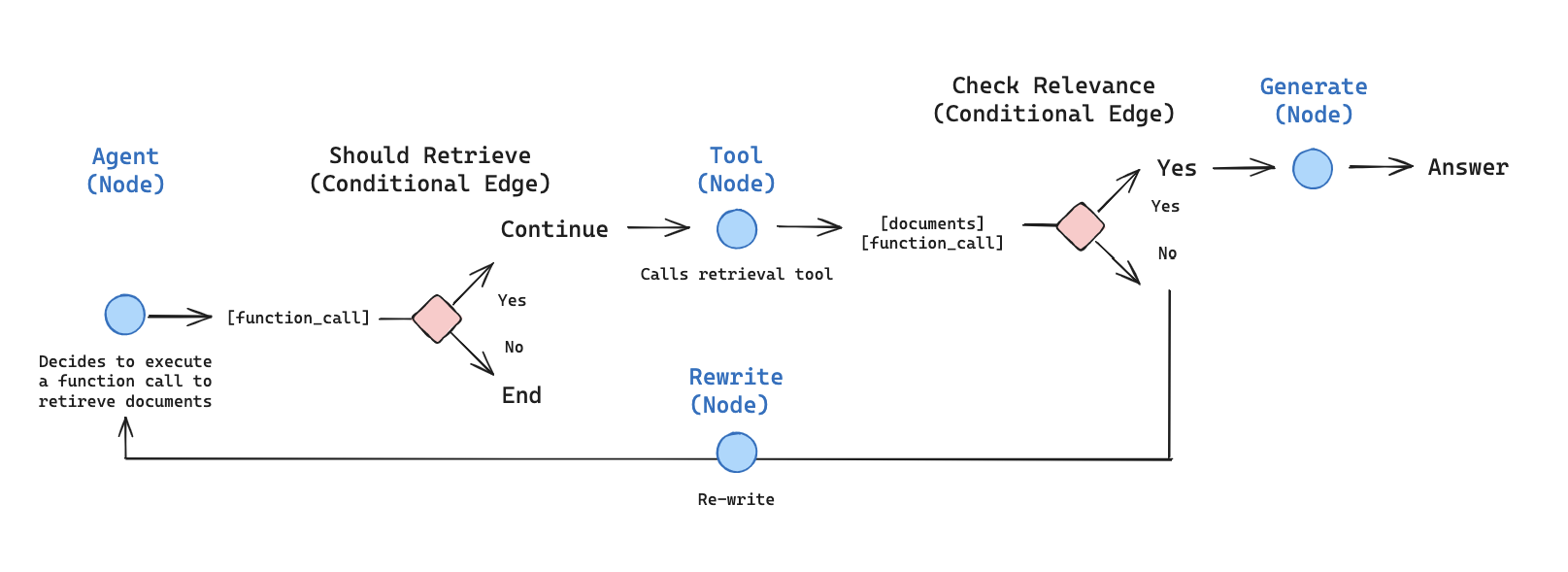
LangChain 提供了内置的智能体实现,这些实现使用了 LangGraph 原语。如果需要更深度的定制,可以直接在 LangGraph 中实现智能体。本指南演示了一个检索智能体的示例实现。当你希望 LLM 决定是从向量存储中检索上下文还是直接响应用户时,检索智能体非常有用。
在本教程结束时,我们将完成以下工作:
- 获取并预处理将用于检索的文档。
- 为这些文档建立语义搜索索引,并为智能体创建一个检索器工具。
- 构建一个能够决定何时使用检索器工具的智能 RAG 系统。
概念
我们将涵盖以下概念:
设置
让我们下载所需的包并设置 API 密钥:
python
pip install -U langgraph "langchain[openai]" langchain-community langchain-text-splitters bs4python
import getpass
import os

def _set_env(key: str):
    if key not in os.environ:
        os.environ[key] = getpass.getpass(f"{key}:")

_set_env("OPENAI_API_KEY")
注册 LangSmith 以快速发现问题并提升你的 LangGraph 项目性能。LangSmith 让你能够使用追踪数据来调试、测试和监控你使用 LangGraph 构建的 LLM 应用。
1. 预处理文档
- 获取用于我们 RAG 系统的文档。我们将使用 Lilian Weng 的优秀博客 中最近的三篇文章。我们将首先使用
WebBaseLoader工具获取页面内容:
python
from langchain_community.document_loaders import WebBaseLoader

urls = [
    "https://lilianweng.github.io/posts/2024-11-28-reward-hacking/",
    "https://lilianweng.github.io/posts/2024-07-07-hallucination/",
    "https://lilianweng.github.io/posts/2024-04-12-diffusion-video/",
]

docs = [WebBaseLoader(url).load() for url in urls]
python
docs[0][0].page_content.strip()[:1000]- 将获取的文档分割成更小的块,以便索引到我们的向量存储中:
python
from langchain_text_splitters import RecursiveCharacterTextSplitter

docs_list = [item for sublist in docs for item in sublist]

text_splitter = RecursiveCharacterTextSplitter.from_tiktoken_encoder(
    chunk_size=100, chunk_overlap=50
)
doc_splits = text_splitter.split_documents(docs_list)
python
doc_splits[0].page_content.strip()2. 创建检索器工具
现在我们有了分割后的文档,可以将它们索引到一个用于语义搜索的向量存储中。
- 使用内存向量存储和 OpenAI 嵌入模型:
python
from langchain_core.vectorstores import InMemoryVectorStore
from langchain_openai import OpenAIEmbeddings

vectorstore = InMemoryVectorStore.from_documents(
    documents=doc_splits, embedding=OpenAIEmbeddings()
)
retriever = vectorstore.as_retriever()- 使用
@tool装饰器创建一个检索器工具:
python
from langchain.tools import tool

@tool
def retrieve_blog_posts(query: str) -> str:
    """搜索并返回关于 Lilian Weng 博客文章的信息。"""
    docs = retriever.invoke(query)
    return "\n\n".join([doc.page_content for doc in docs])

retriever_tool = retrieve_blog_posts- 测试工具:
python
retriever_tool.invoke({"query": "types of reward hacking"})3. 生成查询
现在我们将开始为我们的智能 RAG 图构建组件(节点 和 边)。
请注意,组件将在 MessagesState 上运行——这是一种图状态,包含一个带有聊天消息列表的 messages 键。
- 构建
generate_query_or_respond节点。它将调用一个 LLM,根据当前的图状态(消息列表)生成响应。根据输入消息,它将决定是使用检索器工具进行检索,还是直接响应用户。注意,我们通过.bind_tools让聊天模型能够访问我们之前创建的retriever_tool:
python
from langgraph.graph import MessagesState
from langchain.chat_models import init_chat_model

response_model = init_chat_model("gpt-4o", temperature=0)

def generate_query_or_respond(state: MessagesState):
    """调用模型根据当前状态生成响应。根据问题,它将决定是使用检索器工具进行检索,还是直接响应用户。"""
    response = (
        response_model
        .bind_tools([retriever_tool]).invoke(state["messages"])
    )
return {"messages": [response]}- 在一个随机输入上尝试:
python
input = {"messages": [{"role": "user", "content": "hello!"}]}
generate_query_or_respond(input)["messages"][-1].pretty_print()
输出:
================================== Ai Message ==================================

Hello! How can I help you today?- 询问一个需要语义搜索的问题:
python
input = {
    "messages": [
        {
            "role": "user",
            "content": "What does Lilian Weng say about types of reward hacking?",
        }
    ]
}
generate_query_or_respond(input)["messages"][-1].pretty_print()
输出:
================================== Ai Message ==================================
Tool Calls:
retrieve_blog_posts (call_tYQxgfIlnQUDMdtAhdbXNwIM)
Call ID: call_tYQxgfIlnQUDMdtAhdbXNwIM
Args:
    query: types of reward hacking
4. 评估文档
- 添加一个条件边——
grade_documents——用于确定检索到的文档是否与问题相关。我们将使用一个具有结构化输出模式GradeDocuments的模型进行文档评估。grade_documents函数将根据评估决策(generate_answer或rewrite_question)返回要前往的节点名称:
python
from pydantic import BaseModel, Field
from typing import Literal

GRADE_PROMPT = (
    "You are a grader assessing relevance of a retrieved document to a user question. \n "
    "Here is the retrieved document: \n\n {context} \n\n"
    "Here is the user question: {question} \n"
    "If the document contains keyword(s) or semantic meaning related to the user question, grade it as relevant. \n"
    "Give a binary score 'yes' or 'no' score to indicate whether the document is relevant to the question."
)

class GradeDocuments(BaseModel):
    """使用二元评分评估文档相关性。"""

    binary_score: str = Field(
        description="相关性评分:如果相关则为 'yes',否则为 'no'"
    )

grader_model = init_chat_model("gpt-4o", temperature=0)

def grade_documents(
    state: MessagesState,
) -> Literal["generate_answer", "rewrite_question"]:
    """确定检索到的文档是否与问题相关。"""
    question = state["messages"][0].content
    context = state["messages"][-1].content

    prompt = GRADE_PROMPT.format(question=question, context=context)
    response = (
        grader_model
        .with_structured_output(GradeDocuments).invoke(
            [{"role": "user", "content": prompt}]
        )
    )
    score = response.binary_score

    if score == "yes":
        return "generate_answer"
    else:
return "rewrite_question"- 在工具响应包含不相关文档的情况下运行此函数:
python
from langchain_core.messages import convert_to_messages

input = {
    "messages": convert_to_messages(
        [
            {
                "role": "user",
                "content": "What does Lilian Weng say about types of reward hacking?",
            },
            {
                "role": "assistant",
                "content": "",
                "tool_calls": [
                    {
                        "id": "1",
                        "name": "retrieve_blog_posts",
                        "args": {"query": "types of reward hacking"},
                    }
                ],
            },
            {"role": "tool", "content": "meow", "tool_call_id": "1"},
        ]
    )
}
grade_documents(input)- 确认相关文档被正确分类:
python
input = {
    "messages": convert_to_messages(
        [
            {
                "role": "user",
                "content": "What does Lilian Weng say about types of reward hacking?",
            },
            {
                "role": "assistant",
                "content": "",
                "tool_calls": [
                    {
                        "id": "1",
                        "name": "retrieve_blog_posts",
                        "args": {"query": "types of reward hacking"},
                    }
                ],
            },
            {
                "role": "tool",
                "content": "reward hacking can be categorized into two types: environment or goal misspecification, and reward tampering",
                "tool_call_id": "1",
            },
        ]
    )
}
grade_documents(input)
:::js
- 添加一个节点——
gradeDocuments——用于确定检索到的文档是否与问题相关。我们将使用一个带有 Zod 结构化输出的模型进行文档评估。我们还将添加一个条件边——checkRelevance——它检查评估结果并返回要前往的节点名称(generate或rewrite):
typescript
import * as z from "zod";
import { ChatPromptTemplate } from "@langchain/core/prompts";
import { ChatOpenAI } from "@langchain/openai";
import { AIMessage } from "@langchain/core/messages";

const prompt = ChatPromptTemplate.fromTemplate(
  `You are a grader assessing relevance of retrieved docs to a user question.
  Here are the retrieved docs:
  \n ------- \n
  {context}
  \n ------- \n
  Here is the user question: {question}
  If the content of the docs are relevant to the users question, score them as relevant.
  Give a binary score 'yes' or 'no' score to indicate whether the docs are relevant to the question.
  Yes: The docs are relevant to the question.
  No: The docs are not relevant to the question.`,
);

const gradeDocumentsSchema = z.object({
  binaryScore: z.string().describe("Relevance score 'yes' or 'no'"),
})

async function gradeDocuments(state) {
  const { messages } = state;

  const model = new ChatOpenAI({
    model: "gpt-4o",
    temperature: 0,
  }).withStructuredOutput(gradeDocumentsSchema);

  const score = await prompt.pipe(model).invoke({
    question: messages.at(0)?.content,
    context: messages.at(-1)?.content,
  });

  if (score.binaryScore === "yes") {
    return "generate";
  }
  return "rewrite";
}- 在工具响应包含不相关文档的情况下运行此函数:
typescript
  const input = {
messages: [
new HumanMessage("What does Lilian Weng say about types of reward hacking?"),
new AIMessage({
tool_calls: [
{
type: "tool_call",
name: "retrieve_blog_posts",
args: { query: "types of reward hacking" },
id: "1",
}
]
}),
new ToolMessage({
content: "meow",
tool_call_id: "1",
})
]
  }
  const result